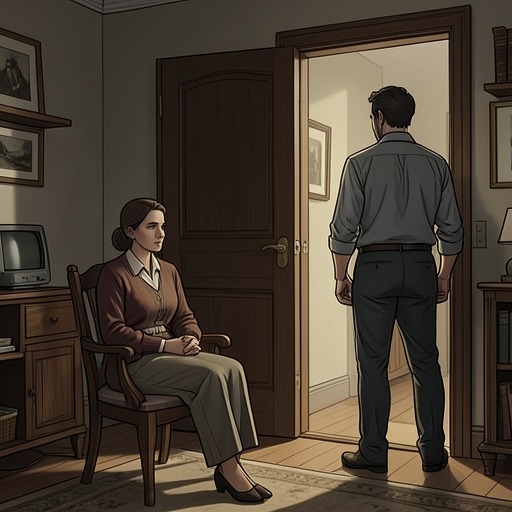
Tom denies the accusations of homosexuality involving Patrick
My PolicemanTom denies the accusations of homosexuality involving Patrick when Marion brings Julia Harcourt’s remark into their home. The exchange exposes how public prejudice and police authority shape a private marriage: Tom rejects the allegation, but does so by invoking the very system that makes such an accusation dangerous. Marion agrees to correct Julia, and the couple’s ensuing closeness offers temporary reassurance without resolving what she has begun to suspect.
Background and Stakes
The conversation begins with Marion’s accumulated frustration, not with a direct accusation. She has been turning over Julia’s comment and the injustice she feels in being expected to accept Tom’s account without question. When Tom returns to the table, she watches him drink tea and recognizes how little she has seen his face during their marital intimacy. By then, their sex has settled into a pattern: every other Saturday, she tells herself, it is becoming a little better. She looks each month for signs of pregnancy and feels hopeful if her period is late. Yet Tom usually turns out the light and buries his face against her shoulder. Her wish for a family and her uncertainty about her husband are therefore already joined before she speaks.
Marion begins with the measured statement that Julia said something about Patrick Hazlewood. She cannot initially bring herself to call the remark awful. Tom sets down his biscuit and asks whether Julia knows Patrick. Marion then names the insinuation indirectly, describing him as comme ça, and finally uses the period’s stigmatizing label for a man presumed to be homosexual. The delay matters: her words emerge haltingly, while Tom’s response becomes a forceful attempt to close the subject.
The danger around the subject is not abstract. Earlier, on 25 October 1957, a newspaper scandal involving senior Brighton CID officers had made Marion fear that ordinary police officers would bear the consequences of their superiors’ disgrace. The account also presents Tom as a serving policeman whose professional world includes vice policing. Against that background, an accusation about Patrick carries implications beyond personal reputation: it touches the force, social standing, and the possibility of official scrutiny.
Denial and Police Respectability
Tom first dismisses Julia’s claim on the ground that she does not know Patrick. When Marion identifies the accusation more plainly, Tom laughs, but the response sounds to her weary rather than amused. He asks how Julia could know such a thing, then supplies his own test for identifying men whom the police treat as homosexual: visible manner, dress, and repeated arrests. He refers to the vice squad’s practice of bringing the same men into the station and to arrests in the public lavatories at Plummer Rodis.
That argument does not establish Patrick’s sexuality; it reveals the terms on which Tom wants Marion to judge him. Tom contrasts Patrick with the men he describes as recognizable targets of police attention, emphasizing Patrick’s respectable occupation and the help he gave the couple with their wedding. Respectability becomes his defense: because Patrick has a job, behaves differently from the stereotype, and has been generous to them, Tom insists that Julia’s conclusion is absurd. His certainty is striking beside the fear Marion has already seen in his face. She recalls his pallor, fixed eyes, and momentary weakness before he gathers himself and demands an explanation of her words.
Tom’s denial consequently works on two levels. He defends Patrick from Julia’s uninformed judgment, but he also redirects Marion toward a socially legible category of homosexual men whom the police can identify and arrest. The distinction protects Patrick only by leaving the prejudicial system itself unchallenged. For Marion, who is trying to decide what the remark means for her husband and home, Tom’s account offers reassurance through a boundary she cannot confidently verify.
Promise and Temporary Reconciliation
Marion’s fear sharpens as Tom’s voice grows cold. She imagines losing her husband, home, and chance of having a family, and recognizes that he could take those things from her. When he asks her to promise that she will correct Julia, the request turns his denial into an obligation for Marion: she is to carry his version of events back into their friendship. She is close to resisting what feels like condescension, but Tom places his hands on her shoulders, kisses the back of her head, and turns her gently toward him. His touch eases her immediate anger and leaves her exhausted. She agrees.
The apparent domestic ease that follows is brief and carefully limited. Tom speaks affectionately about the chips Marion is preparing, but she expects that they will say nothing more about the subject that evening. Instead, he initiates an unusually intense intimacy. Marion remembers it as the only time he undressed her; for that night, the encounter makes her feel that he means the marriage, and she sleeps beside him without dreaming. This change does not prove that his denial has answered her questions. It shows how physical closeness can suspend the conflict and make the marriage feel secure again, at least temporarily.
In the weeks that follow, Tom tells Marion that he will continue seeing Patrick regularly to finish the portrait, adding Saturday afternoons to Tuesday evenings. Patrick also visits their home, bringing wine and talking about plays and films. Marion does not protest. She agrees to let Patrick’s museum arrange an art-appreciation afternoon for her class, partly to reassure Tom that she has put Julia’s remark aside, and partly because she wants to assess Patrick privately. The accusation therefore changes Marion’s attention even though the household resumes its routines.
Later Significance
The scene’s consequences extend beyond its immediate reconciliation. At Patrick’s later trial, Marion is asked directly whether Patrick had an indecent relationship with her husband and whether she denies that the accused is homosexual. The courtroom question makes public and consequential the claim she had first struggled to voice at home. Her earlier promise to correct Julia sits uneasily beside that later moment, when the accusation is no longer private gossip but part of a prosecution.
The episode’s central tension is that Tom’s defense of Patrick and his defense of himself are difficult for Marion to separate. His appeal to Patrick’s respectability may be sincere, and his tenderness toward Marion is real as she experiences it; neither settles the question she is afraid to pursue. The scene thus shifts the marriage from unspoken unease to a carefully managed silence. Tom has secured Marion’s agreement, but the detail of his reaction, her continued scrutiny of Patrick, and the later courtroom challenge show that the underlying uncertainty has not gone away.